Thai Fried Red Sausage

Regional

View on world map

Thai Fried Red Sausage hot dog

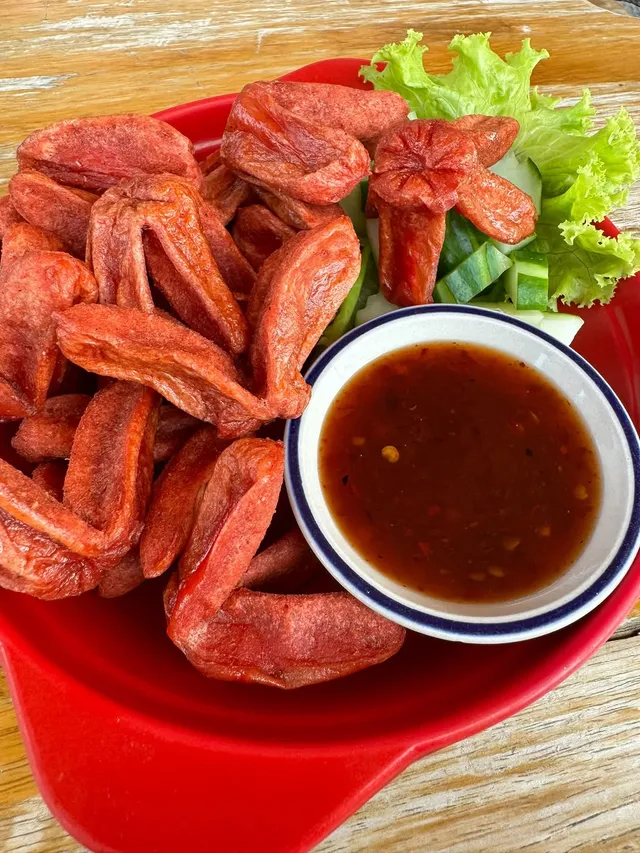
The legendary red sausage of Thailand's school gates: small red chicken franks, scored and deep-fried until the cuts bloom open and the skin turns crisp, eaten hot from the stall tray with a tamarind chilli dip, cucumber and cilantro. It is sold bun-less, on skewers and in cups – and it is this catalog's standing exception: a hot-dog frank whose documented Thai form is a street sausage, presented here as it is actually sold.

Thai Fried Red Sausage: crisp, bloomed red sausages with cucumber and dark chilli dip
History

Ask a Thai adult about the red sausage and you will usually get a story about school. The fried-snack stall outside the school gate – the luk chin stall, with its tray of fish balls, meatballs and sausages under a glass case – is where generations of Thai schoolchildren spent their snack money, and the red sausage was its star: so much a shared memory that Thais nickname it ไส้กรอกแดงในตำนาน, "the legendary red sausage."

The sausage itself is the hot dog as Thailand industrialised it: a small, cheap, factory-made chicken frank, a carnival red that no one mistakes for nature. Brands compete on how much real chicken is in it – the vendor-standard brand, Laemthong, advertises 70 percent chicken and beechwood smoke – but the form never changes: a short red frank, sold raw in plastic packs at every market, waiting for the fryer.

The stall treatment is the craft. Each sausage is scored – cross-hatch cuts, or a diagonal slash – and fried slowly until the cuts open, the skin puffs and crisps, and the sausage blooms like a flower. Stallholders fry them to the edge of bursting; they relax a moment out of the oil, crisp outside, soft inside. Then comes the sauce: the fried-snack dip, thick and brown, sweet, sour and hot in one spoonful, poured over the top – and cucumber, cilantro or cabbage alongside to cut the grease. Eaten standing at the stall, off a skewer or out of a cup, sometimes with sticky rice. That is the whole dish, and it has never needed a bun.

The bun is the one thing Thailand didn't do with it. Hot dogs in buns exist in Thailand, but they are the American format, sold as such. The flower-fried red sausage belongs to the stall tray, and Thai photography of it – thousands of posts, reels and recipes – shows it plated or skewered every single time. When the national suki chain Suki Tee Noi put "Red Sausage in Front of School" on its menu in April 2026 as a nostalgia special, it served the sausages exactly as the stalls do: fried, bloomed, with the dip. No bun. That August, the chain brought the sausage back as a permanent menu item.

So this page keeps the catalog's one honest exception. Hot-Dog-o-Pedia is a catalog of hot dog styles, and the rule is a sausage in a bun – but Thailand's documented form of the dish is a street sausage, diffused across a whole country's school gates and markets, and its street roots, nostalgia, pervasiveness, and notriety make it a bunless Hot-dog-o-pedia exception.

* Listed under the exception in our Inclusion Criteria: a documented street sausage admitted notwithstanding the complete absence of a bun, or of anything performing the bun's office. Thailand never put it in one; neither, in the end, did we.

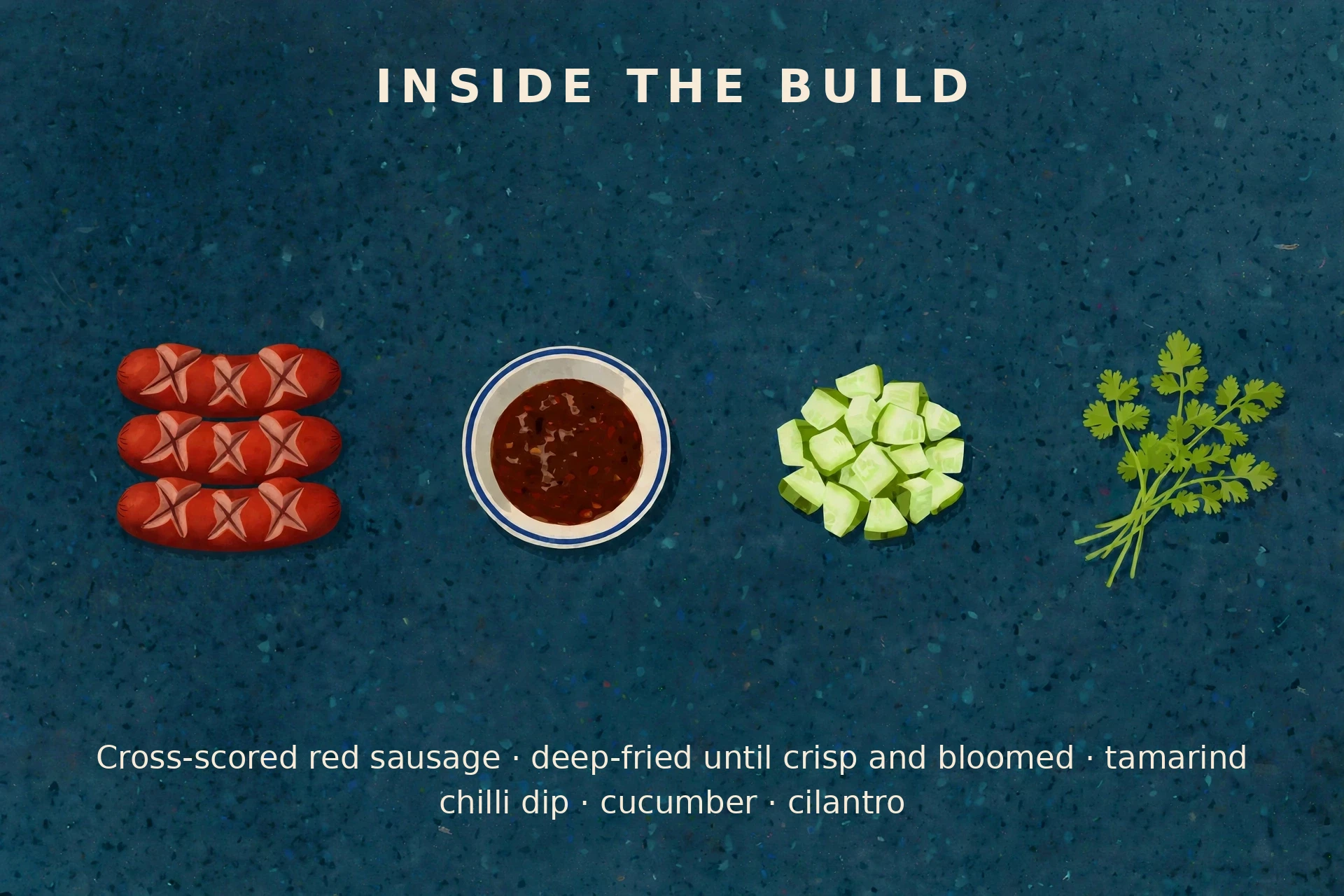
Inside the Build

Inside the Build illustration for Thai Fried Red Sausage: Thai red sausages (small chicken franks), cross-scored and deep-fried until crisp and bloomed, Tamarind chilli dip (the stall's luk-chin dipping sauce), Cucumber (chunks or thick slices), Cilantro sprigs, in serving order.

Cross-scored red sausage · deep-fried until crisp and bloomed · tamarind chilli dip · cucumber · cilantro

Make it at home

This is the documented street form, using the vendor-taught technique published by KRUA.CO (learned from a working stallholder) and the standard tamarind dipping sauce. Makes one generous snack plate to share – the stall sells by the piece; a home batch of a dozen sausages is about right.

About this recipe

This is the documented street form, using the vendor-taught technique published by KRUA.CO (learned from a working stallholder) and the standard tamarind dipping sauce.

We haven’t kitchen-tested this version. Portions and timing are a guide for home cooking; follow any specific package directions in the recipe.

Last checked: .

Ingredients

  • 12 Thai red sausages (small chicken franks; Laemthong if you can find them, any Thai-style red frank otherwise)
  • Neutral oil, for deep-frying (enough to cover the sausages)
  • 80 g Wet tamarind — for the dip
  • 3 cups Water — for the dip (2 cups to extract the tamarind, 1 cup to rinse the blender)
  • 4–6 Fresh red jinda chilies (to heat) — for the dip
  • 6 Dried red chilies — for the dip
  • 6 Garlic cloves — for the dip
  • 1¼ cups Unrefined sugar, plus 1 cup coconut sugar — for the dip
  • 1 tablespoon Sea salt — for the dip
  • 1 Cucumber (cut in chunks or thick slices) — to serve
  • A handful of Cilantro sprigs — to serve
  • Cabbage wedges (optional) — to serve
  • Sticky rice (optional, as eaten after school) — to serve

Instructions

  1. Score each sausage with cross-hatch cuts about 5 mm deep – the original stall cut. Don't go deeper; the cuts open wider than you expect.
  2. Make the dip: simmer the tamarind and jinda chilies in 2 cups of the water until the tamarind softens; squeeze and strain out the pulp and seeds, keeping the chilies with the liquid.
  3. Fry the garlic in a little oil until nearly golden, add the dried chilies and fry a moment more; drain.
  4. Blend the tamarind liquid and chilies with the fried garlic and chilies until smooth. Return to the pot, using the remaining 1 cup of water to rinse the blender into the pot. Season with the sugar and salt, and simmer gently about 10 minutes, until thick and glossy. Set aside; top with a fried chili or two if you kept any back. The dip contains no starch — it thickens by reduction alone.
  5. Fry the sausages the stall way: put them into cold oil, then turn on a low heat. Keep the heat low the whole time, stir so they colour evenly, and fry about 20 minutes from the point the oil boils and the sausages begin to puff – the cuts should bloom open and the skins turn crisp. (A sausage lifted out to test should not wrinkle as it cools; if it does, it needs longer.)
  6. Finish with 30 seconds to 1 minute at high heat to drive off the oil, then lift out and drain on a rack.
  7. Serve at once, hot, with the tamarind dip for dunking or poured over, and the cucumber, cilantro and cabbage alongside.

Local favorites

Where to Try It

Every restaurant below is in this style's home turf – the place it comes from. We check each listing against the venue's own menu or website where we can, but menus change – treat this list as a starting point, and confirm before you make the trip.

(this isn't a "near you" list)

Suki Tee Noi — Ban Bang Khen branch (สุกี้ตี๋น้อย บ้านบางเขน)

17 Phahonyothin Rd, Anusawari, Bang Khen, Bangkok 10220, Thailand (17 ถนนพหลโยธิน แขวงอนุสาวรีย์ เขตบางเขน กรุงเทพมหานคร 10220)

The school-front sausage, served by a national chain. This is Suki Tee Noi's first branch, opened in 2018; it moved within the Ban Bang Khen complex, remaining at the same site. The suki buffet chain put "Red Sausage in Front of School" on its buffet in April 2026 as a nostalgia special, then made the fried red sausage a permanent menu item that August – the same small red franks, fried crisp, eaten with dipping sauce as part of the buffet. The easiest place in Thailand to try the form today.

Kiao Tod Mor (เกี๊ยวทอดหม้อ)

Sao Chingcha (Giant Swing), Phra Nakhon, Bangkok — behind the Ministry of Interior; also opposite Phraeng Sapphasat, near the Chao Pho Suea shrine.

The old-town cart the Sao Chingcha district is famous for. Its name means "pot-fried wontons," and the wontons are half the story – the other half is its twisted red sausages, fried in the same pot until they puff and crisp, then drowned in the cart's dark tamarind sauce. Coverage by EatGuide called the sausages legendary; the cart sells out within a few hours, so go around midday.

This style lives at street stalls, not restaurants – the fried-snack stalls outside schools and in markets all over Thailand, where the red sausages share a tray with the fish balls and meatballs. The two listings above are the named exceptions we have verified; the stall with the longest queue of schoolchildren is still the classic way to find it.

Related Styles (kinda)

4 similar styles