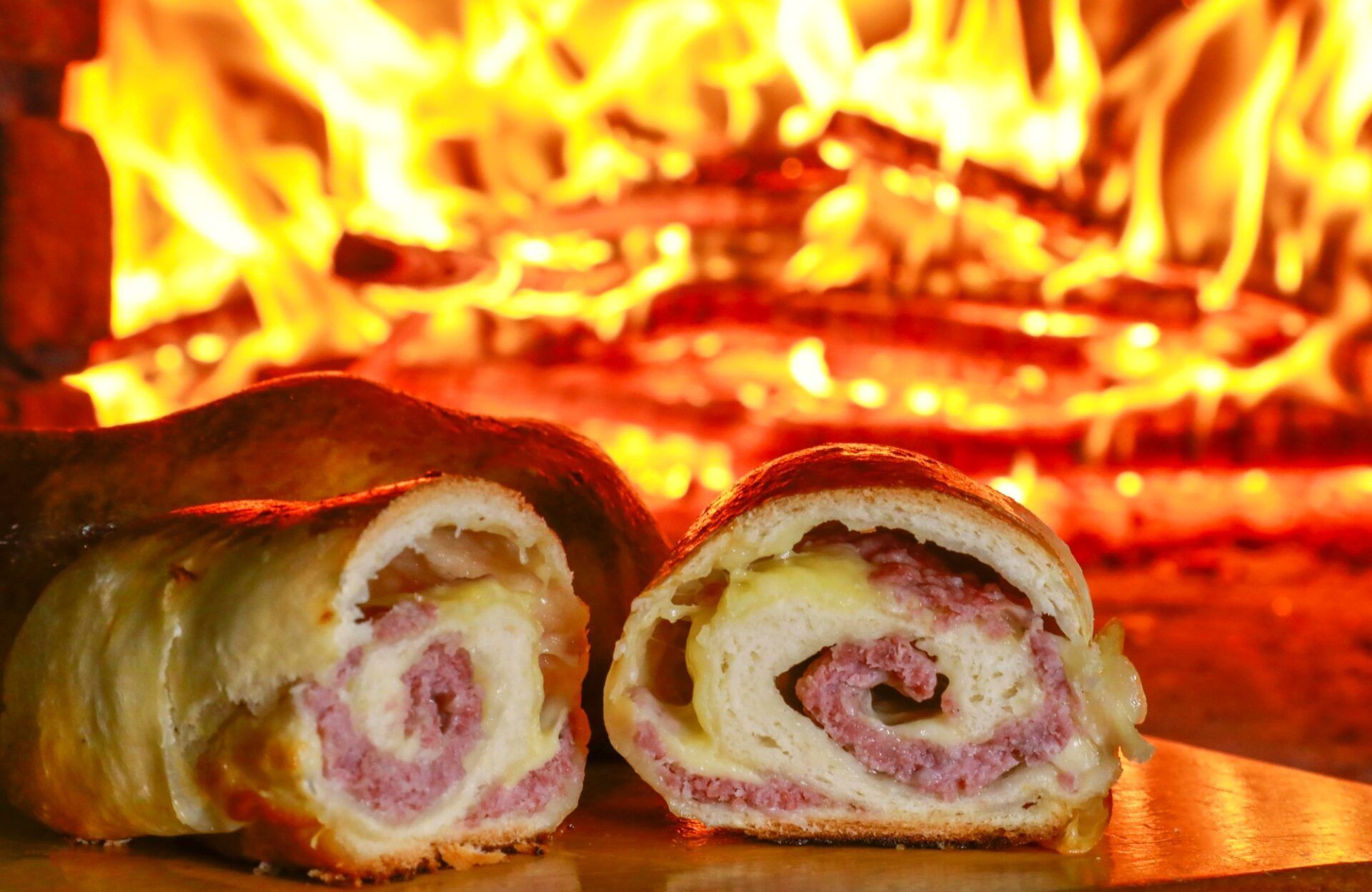
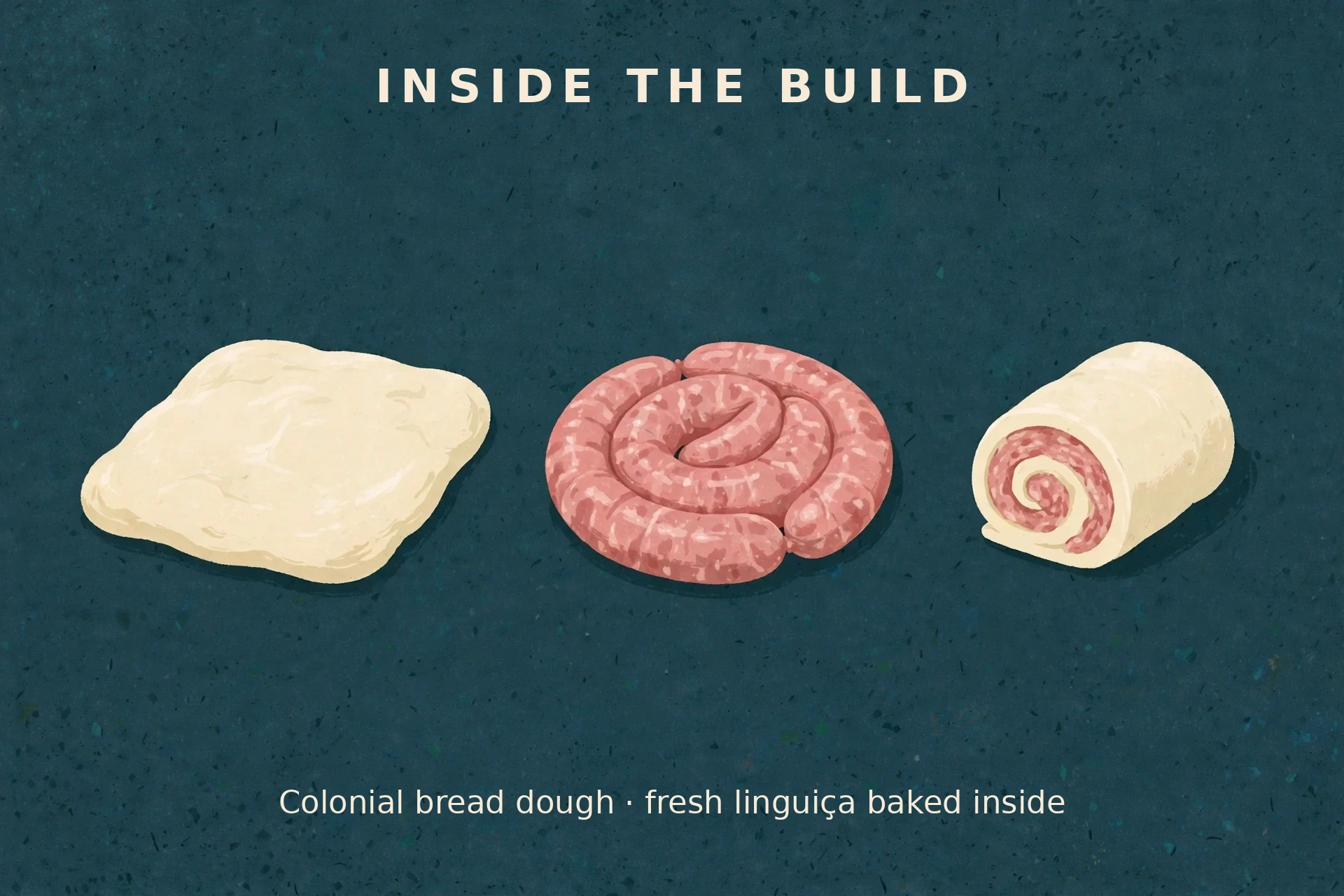
A Gramado colonial loaf with the sausage baked inside: fresh linguiça enclosed in lard-enriched colonial bread dough and baked in communal wood-fired ovens, sold warm by the Serra Gaúcha's rotating farm families.
For the broader Brazilian tradition and its regional variants, read the Cachorro Quente overview.
Pão com Linguiça de Gramado begins where Gramado itself begins: on the farm properties of the Serra Gaúcha, settled in the nineteenth century by German, Italian and Portuguese immigrants whose sausage-making and bread-baking became the region's daily grammar. On bread day, the clay oven that baked the household loaf baked a second thing alongside it — fresh linguiça from the home pig slaughter, laid into the raw colonial dough so that sausage and bread cooked together. Farmers' families still tell it that way: Jurema Lurdes Weber remembers running after her mother as a small child while the pão com linguiça went into the forno de barro, and her granddaughter tells the same story a generation on.
The farmhouse loaf became a town institution through the fornos coloniais — the communal wood-fired ovens where Gramado's rural families bake in rotation. At the ovens of the Praça das Etnias, run by the Associação dos Fornos de Gramado, and at the second oven site in Várzea Grande, some 200 farming families now share the baking and the selling, and the pão com linguiça — R$9, warm from the oven — is the signature of the counter, moving thousands of units a day in high season. It is not a restaurant dish and never was: it is a producer system you can eat.
In October 2026 the town wrote the loaf into its own record. On 5 October the Câmara Municipal unanimously approved the bill declaring the artisanal making of Pão com Linguiça de Gramado part of the municipality's intangible cultural heritage, on the basis of a formal heritage research report documenting the method — the colonial sausage placed directly in the raw colonial bread dough, then baked, traditionally over wood fire. A cousin stands nearby in this catalog: the salsipão, whose grilled sausage is laid into a split roll. Gramado's loaf does the opposite — raw sausage, raw dough, one bake.
Pão com Linguiça de Gramado (home version, makes 4 loaves)
The documented construction — fresh linguiça baked raw inside colonial bread dough — scaled for a home oven. The sausage goes in raw; that is the whole point. The exact quantities are a home scaling, not a published heritage formula: the oven loaves are made by hand and eye, and no fixed formula is documented.
About this recipe
The documented construction — fresh linguiça baked raw inside colonial bread dough — scaled for a home oven. The sausage goes in raw; that is the whole point. The exact quantities are a home scaling, not a published heritage formula: the oven loaves are made by hand and eye, and no fixed formula is documented.
100 g grated queijo colonial or a young, mild melting cheese (cheese is in Emater's traditional ingredient list and the loaves with cheese are sold at the same ovens; the plain linguiça loaf is the canonical form, and the loaves are also sold plain).
Method:
Mix flour, yeast, sugar and salt; add the egg, lard and warm water and knead 8–10 minutes to a smooth, soft dough. Cover and rise until doubled, about 1 hour. (The traditional Serra Gaúcha levain for pão colonial is a potato ferment; yeast is the practical home levain and changes the method least.)
Roll the dough out to a rectangle roughly 40 × 30 cm. Spread the raw sausage meat evenly over it, leaving a border; scatter the cheese if using.
Roll up firmly from a long side, pinch the seam, and cut the roll into 4 pieces. Set seam-down on a lined tray, cover, and proof 30–40 minutes.
Bake at 220 °C (425 °F) for 25–30 minutes, until deep golden and the sausage is cooked through (the centre should read 74 °C / 165 °F). In Gramado this bake happens in a wood-fired oven; a hot home oven is the honest equivalent, not a shortcut.
Eat warm, out of hand, the way the oven counter serves it.
On the sausage, honestly:
outside Brazil, buy the freshest uncured coarse pork sausage you can — fresh Italian pork sausage, fresh bratwurst or fresh Portuguese linguiça are the nearest honest equivalents, and they are substitutes, labelled as such. Do not use a smoked or cured sausage and call it the same thing: the regulated Brazilian product actually named "linguiça colonial" is a cured, smoked, salame-style sausage, and it is not what Emater describes going into Gramado's dough. The farmhouse original is fresh sausage, and the bake cooks it.
The original colonial ovens, run by the producers' association; the pão com linguiça (R$9) is the counter's signature, baked by whichever farm family holds the rotation.
The neighbouring town's own colonial ovens, two farm families rotating; pãozinho de linguiça e queijo on the board. (The oven structure is being rebuilt on the same square — the new structure is due by July 2027; sales continue meanwhile from a temporary structure nearby, per the municipality.)